

By Jamie Munoz featuring Lani Koontz
Based on the AI Momentum Protocols methodology, developed by Rachel Woods
EOS has always included this foundational belief: if no one owns it, it does not get done.
That principle applies to sales. It applies to operations. It applies to finance. And right now, it applies to AI.
AI Is Happening. But Nobody Owns It.
Right now, most EOS companies have AI activity scattered across every department.
Marketing is testing prompts. Sales is automating outreach. Operations is experimenting with workflows.
Nobody is tracking what is working, what is being duplicated, or what is creating risk.
The result is predictable:
Fragmented tools
Inconsistent outputs
Duplicated effort
No standards or governance
No measurable ownership
In EOS language, the issue is simple: there is no accountable owner. And when something operationally critical lacks ownership, friction follows.
Your Accountability Chart has an empty seat. The AI Momentum Protocols methodology, developed by Rachel Woods, names it: the AI Operator.
What the AI Operator Is Accountable For
The AI Operator is not the AI enthusiast on your team. This role owns how AI functions operationally inside the business. That accountability includes:
Building and maintaining the company’s AI playbook library
Standardizing AI workflows and usage across departments
Training the team and driving adoption
Evaluating tools and integrations
Governing usage standards and protecting company data
Tracking efficiency gains and reporting measurable ROI into the Scorecard at every L10
This is not experimentation. It is operational ownership.
One important distinction: AI literacy is not a seat. Every person on the team needs baseline skills for working with AI, the same way everyone needs to know how to use a spreadsheet. That is a foundation. The AI Operator owns the system those skills run on.
“Every company we work with has people using AI. That's not the differentiator anymore. The differentiator is whether someone owns it. One person driving the system, documented playbooks, and a team that actually runs on them. That's what separates using AI from operating with AI.” Rachel Woods, Founder, AI Momentum Protocols
Where This Seat Lives on the Accountability Chart
Like every EOS seat, the AI Operator evolves as the company grows.
Stage 1: Fractional AI Operator
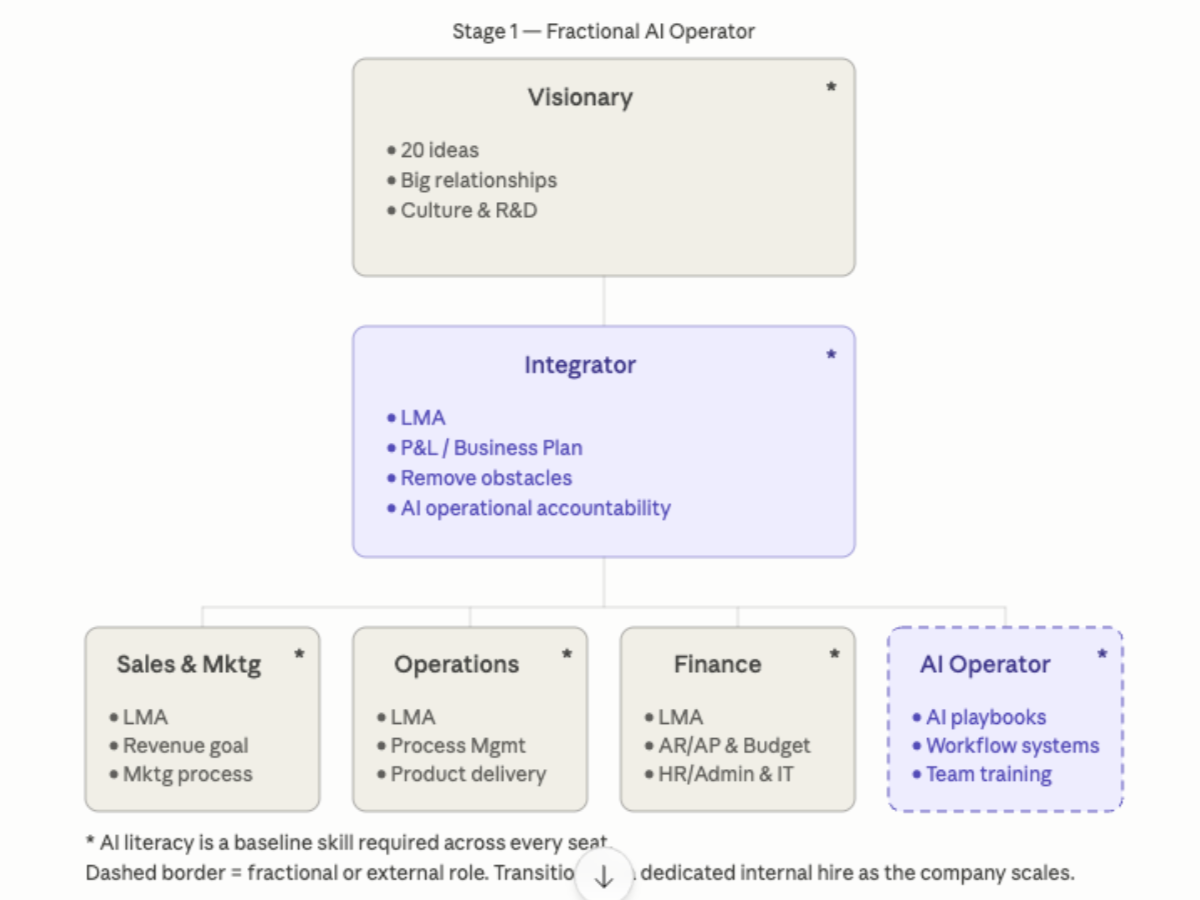
Most companies are not ready for a full-time AI Operator on day one. That is normal.
The EOS ecosystem has already solved this pattern. Companies bring in Fractional Integrators and Fractional CFOs before the volume justifies a permanent hire. A Fractional AI Operator works the same way.
At this stage, the AI Operator sits at the director level, the same standing as Directors of Sales, Operations, and Finance, and reports directly to the Integrator. That reporting line is intentional. The Integrator already owns execution and removes obstacles across the business. Giving the AI Operator a direct line to that seat keeps AI work connected to operational priorities, not floating as a side project.
The Visionary’s role here is focused: approve the investment and ask whether AI work is pointed at the right business problems.
The AI Operator builds the playbook library, establishes governance, trains the team, and hands a functioning AI operating system to an internal owner when the company is ready. The capability comes before the full-time seat. Every time.
Stage 2: Dedicated AI Operator Seat
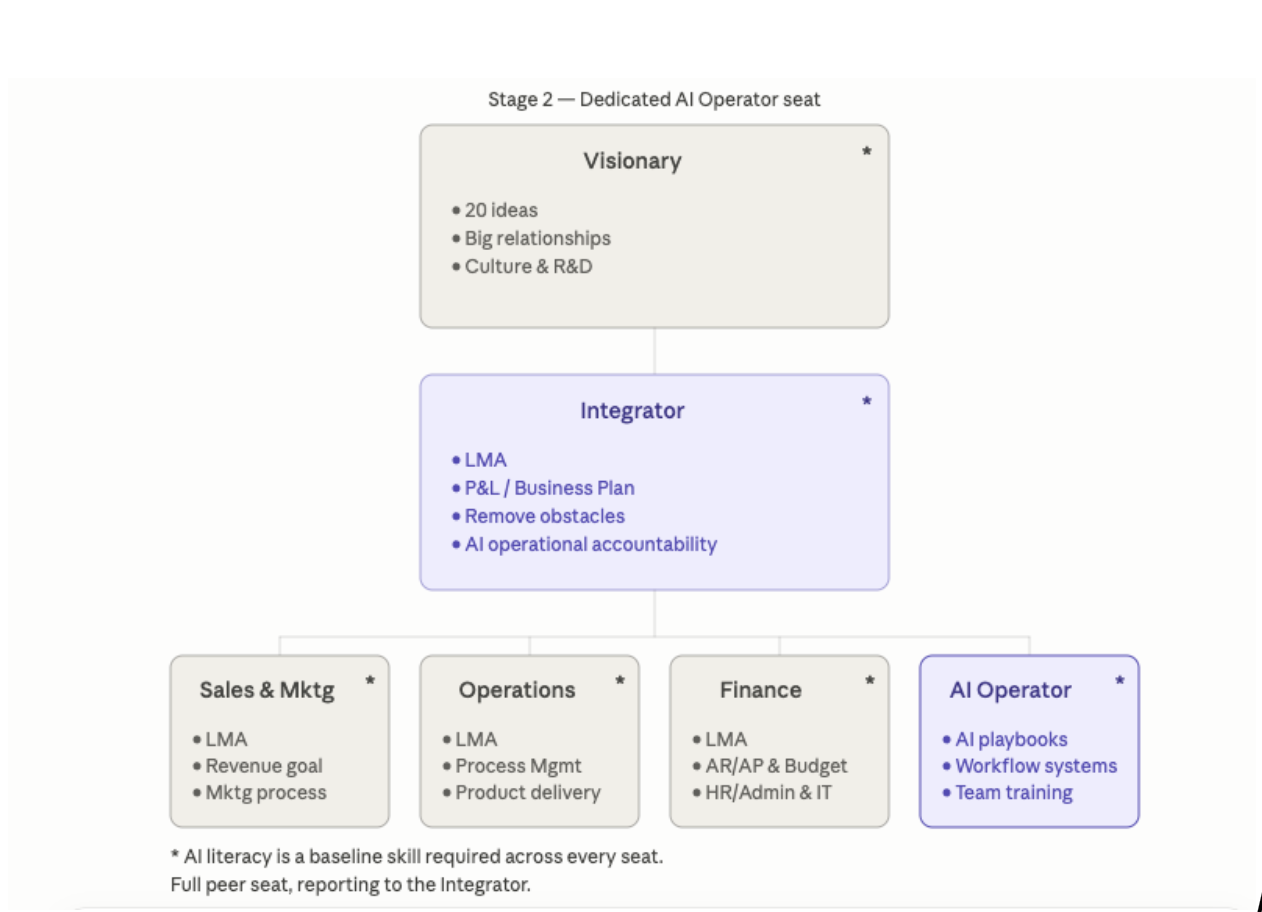
For larger organizations or companies treating AI as a strategic differentiator across every function, the AI Operator becomes a full peer seat with the same standing as every other department lead.
At this stage, AI is no longer an initiative. It is infrastructure.
Why EOS Companies Are Built for This
EOS businesses already practice what most companies struggle to install: accountability, documented processes, and execution cadence. That foundation is exactly what makes AI adoption stick.
Without structure, AI creates fragmentation. With accountability, AI creates compounding operational leverage.
The Accountability Chart has always evolved alongside business complexity. Companies once operated without dedicated HR, Finance, or Customer Success seats. Today those seats are essential. AI ownership is entering that same category.
Not because AI replaces people. But because someone has to own how people and AI work together operationally.
The companies that fill this seat now will not just run better. They will set the standard for what the next era of operational excellence looks like.
